A ceiling leak in Mesa is usually a monsoon problem. Roughly 60 to 70% of the roof leaks handled between July and September trace to blown-off shingles, cracked tile underlayment, or wind-driven rain forcing water past…
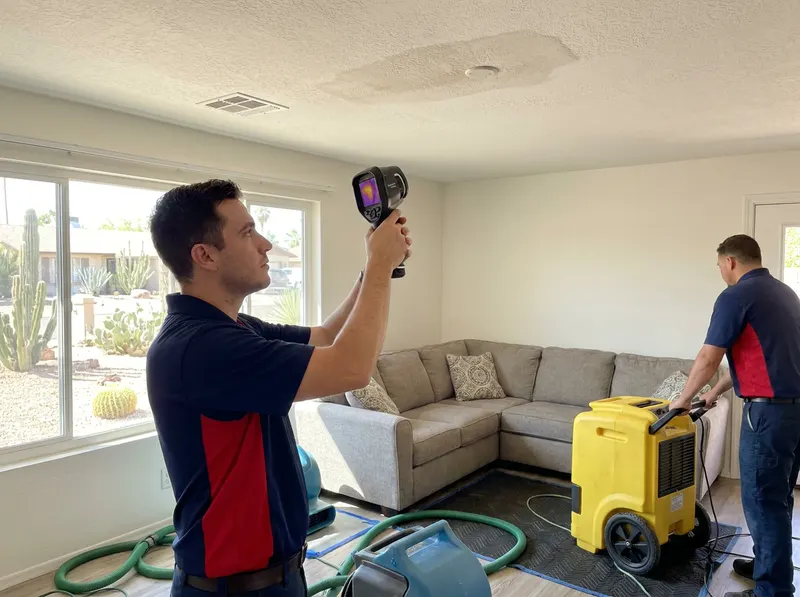
A ceiling leak in Mesa is usually a monsoon problem. Roughly 60 to 70% of the roof leaks handled between July and September trace to blown-off shingles, cracked tile underlayment, or wind-driven rain forcing water past flashing during a haboob. The water rarely appears where the roof failed; it travels along a truss and drops through the lowest point, so a stain in a Red Mountain Ranch living room can start ten feet away above the garage. Drying the ceiling correctly means finding the true wet zone first with a moisture meter and thermal reading, not just the visible spot.
The drying sequence is straightforward. First, the attic space is inspected and any pooled water on top of the drywall is extracted. Second, saturated blown-in fiberglass or cellulose insulation is bagged and removed, because wet insulation holds moisture against the ceiling for weeks and drops its R-value near zero. Third, small weep holes are drilled at the low points of a bulging ceiling to release trapped water before drywall tears loose. Fourth, air movers are aimed into the cavity and dehumidifiers pull the humidity down, with wood moisture content logged daily until framing reads dry. In older Sunland Village and Lehi homes with flat or low-slope roofs, water often spreads across a wide area, which adds a day of drying compared with a pitched roof in Eastmark or Augusta Ranch.
Drying suits a ceiling caught early, when the drywall is stained but structurally intact and the leak is now stopped. If a Mountain Bridge or Alta Mesa ceiling is already sagging, crumbling, or has been wet for more than a few days, the saturated drywall panel is usually removed rather than dried, since gypsum that has held water tends to lose strength and can hide mold on its paper backing. The trade-off is cost and disruption: drying a stained but solid ceiling preserves the panel and paint for a few hundred dollars, while a wet, sagging panel means demolition and later rebuild. A leak from a Superstition Springs tile roof that only wet the underlayment paper may need little more than a day of airflow.
Ceiling drying is not the same as roof repair, and it is not the same as a mold job. Drying removes the moisture; the roofing contractor must seal the leak source, or the ceiling wets again with the next storm. If a leak sat undetected for weeks and mold is already visible on the framing, that becomes a separate containment and removal scope. Call to describe the stain and, if it is safe, note whether the ceiling is bulging or dripping so the right crew and equipment arrive on the first trip.
Every job gets a firm, written price after a free on-site visit.
Tell us about your ceiling & roof leak drying job in Mesa and we'll send a clear, written quote, usually the same day.
 Water Damage Restoration Mesa