Mold in Mesa homes is driven by hidden moisture, not humidity, the outdoor air stays dry, so growth almost always traces back to a specific water event: a slab leak under a Dobson Ranch hallway, a slow supply line…
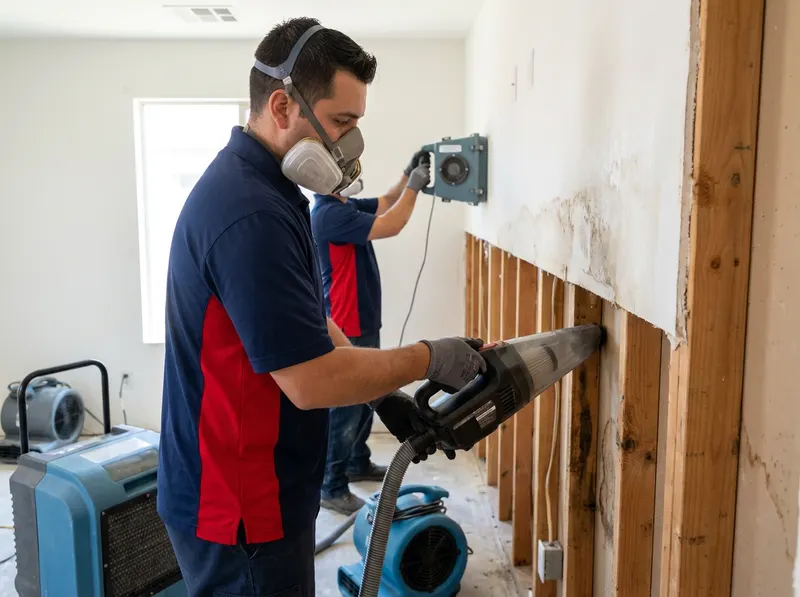
Mold in Mesa homes is driven by hidden moisture, not humidity, the outdoor air stays dry, so growth almost always traces back to a specific water event: a slab leak under a Dobson Ranch hallway, a slow supply line behind a Sunland Village kitchen, or a roof leak after a monsoon storm near Red Mountain Ranch. The remediation process follows the same sequence every time. First, the moisture source is confirmed and stopped, because treating mold without fixing the leak guarantees regrowth. Second, plastic sheeting seals the work area and a negative-air machine with a HEPA filter pulls spores out of the room instead of letting them drift into the rest of the house. Third, porous materials that hold mold, drywall, insulation, carpet pad, are cut out and bagged. Fourth, remaining framing and subfloor are treated with an EPA-registered antimicrobial. Fifth, the cavity is dried with air movers and a dehumidifier until a moisture meter reads back at normal dry-standard levels for the surrounding wood.
Remediation fits when water sat long enough to grow visible mold or when a musty smell persists after a cavity was supposedly dried. If the leak was caught within the first day and the area was dried immediately, straight water extraction and drying is usually enough and mold work is unnecessary, that is the cheaper path and worth confirming with a moisture reading before opening walls. If discoloration covers more than about 10 square feet, or spreads across multiple rooms in a home like those in Eastmark or Mountain Bridge, the job moves into full containment with clearance testing rather than a spot cleanup. The trade-off is straightforward: a spot treatment is faster and cheaper but risks leaving colonized material behind a wall, while full containment costs more and takes days but removes the source and verifies the space is dry.
Older Mesa neighborhoods bring specific patterns. Slab-foundation homes in Alta Mesa and Lehi tend to hide mold at the base of walls after slab leaks, where wicking pulls moisture up the drywall. Two-story homes in Las Sendas and Augusta Ranch more often show mold on upper-floor ceilings below a failed rooftop AC line or an upstairs bathroom leak. Water heaters in garage closets across Superstition Springs are a common quiet source, a weeping tank can grow mold in the shared wall before anyone notices the puddle.
A moisture reading before any demolition tells you whether the problem is active or already dry, which decides how much material actually needs to come out. Clearance at the end confirms the cavity reads dry so the wall can be rebuilt with confidence. Reconstruction, new drywall, texture, and paint, is a separate step handled after clearance.
Every job gets a firm, written price after a free on-site visit.
Tell us about your mold remediation after water damage job in Mesa and we'll send a clear, written quote, usually the same day.
 Water Damage Restoration Mesa