Monsoon rain in Mesa does not behave like a slow plumbing leak; it dumps 1 to 2 inches in under an hour, and the ground in the East Valley is caliche-hard clay that sheds water rather than absorbing it. That runoff…
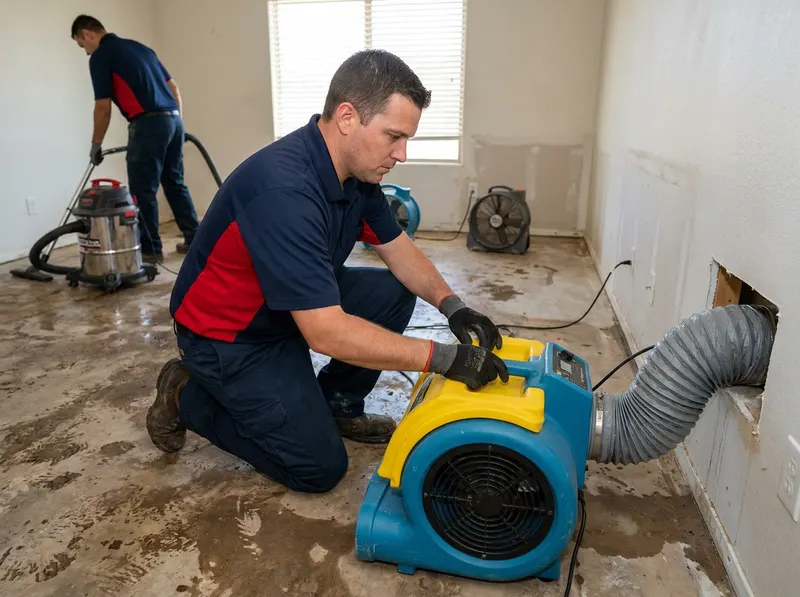
Monsoon rain in Mesa does not behave like a slow plumbing leak; it dumps 1 to 2 inches in under an hour, and the ground in the East Valley is caliche-hard clay that sheds water rather than absorbing it. That runoff finds the lowest opening in a home. In older Sunland Village and Dobson Ranch properties, that is often an aging flat-roof seam or a west-facing sliding door where the weatherstrip has hardened. In hillside neighborhoods like Las Sendas, Red Mountain Ranch, and Mountain Bridge, sheet flow off the slope pools against garage doors and side gates before it drains. The first job is always the same: extract standing water before it wicks up drywall, because gypsum board pulls moisture roughly 1 inch per hour and studs behind it stay wet long after the floor looks dry.
The cleanup runs in a set sequence. First, the water is pumped and vacuumed out. Second, a moisture meter maps how far the water traveled behind baseboards and under flooring, since monsoon water almost always spreads farther than the visible edge. Third, air movers and dehumidifiers are set to dry the structure to a stable moisture reading, typically over 3 to 5 days. Fourth, wet drywall and insulation that cannot be dried are cut out, and framing is treated with an antimicrobial to block mold, which can start colonizing in as little as 24 to 48 hours in Mesa's warm summer indoor temperatures.
Storm flood water is usually Category 1 (clean rainwater) when it enters through a roof or window, which means fast drying can save the drywall and flooring. Water that enters at ground level through a garage, a flooded wash near Lehi, or a backed-up patio drain often carries yard soil and debris, pushing it toward Category 2 or 3 and requiring removal of soaked carpet pad and lower drywall rather than drying in place. The trade-off is speed against salvage: the sooner extraction starts, the more materials dry out and stay; wait past a day and cut-out and replacement costs climb. Homes in newer master-planned areas like Eastmark and Augusta Ranch tend to have tighter building envelopes, so storm intrusion there is more often a single point (a failed roof penetration or window) rather than whole-home flooding.
After drying is verified, the work either closes out at the dry-out stage or moves into rebuild, reinstalling baseboard, replacing cut drywall, and repainting. Insurance treatment matters here: sudden storm damage from a covered event is commonly claimable, but flooding from surface water or a nearby wash may fall under a separate flood policy, so documenting the source with photos at the start protects the claim either way.
Every job gets a firm, written price after a free on-site visit.
Tell us about your monsoon & storm flood cleanup job in Mesa and we'll send a clear, written quote, usually the same day.
 Water Damage Restoration Mesa